
My 1965 Honda Dream Has Become a Nightmare
By Geoff Drake
Originally published in BMW Owners News.
Long-suffering readers will remember my optimism upon acquiring a 1965 Honda Dream barn find. This beautiful, if rusty and rodent-infested, 305-cc motorcycle had been laying on its side in a damp barn for 61 years, but was otherwise complete in every way, right down to the swoopy, Art Deco fenders, square headlamp, chrome knee guards, whitewall tires, and tiny, jewel-like speedometer. Best of all, it was free!
But as every restorer knows, there’s no such thing as a free motorcycle. Or so I’ve discovered….
I’ve long prided myself on the fact that no old motorcycle has defeated me—though my bank account has often been severely damaged in the process. I’ve found an ignition spark where there was none; I’ve removed and replaced wiring harnesses that looked like dying, deep-sea creatures; and I’ve replaced enough bushings and bearings to make the world turn on its axis. And then there was my proudest bodge, when I rescued a long-distance trip by fixing a fried fuel pump controller on an old BMW with a couple of wire nuts and pieces of my heated vest cord. I may have been cold, but I made it home.
The Honda Dream, however, may just be my Waterloo. This bike is like a recalcitrant child, reluctant to yield to gentle persuasion, bribes, irrational outbursts, or threats of violence.
In short, my dream of a Honda Dream is as frozen as its pistons.
The Adventure Begins
It started well enough. Filled with the hope and confidence borne of ignorance, I threw myself into the project. This would be my most challenging and rewarding restoration yet, given the age and decrepitude of the old Honda. Getting the bike back on the road, I figured, would be a service to humanity. After all, I’d be preserving a piece of mechanical history from the age of fuel taps, dip sticks, and friction dampers.
I’d gone so far as to get quotes on blasting and powdercoating the monocoque frame, and Cerekoting some engine parts.
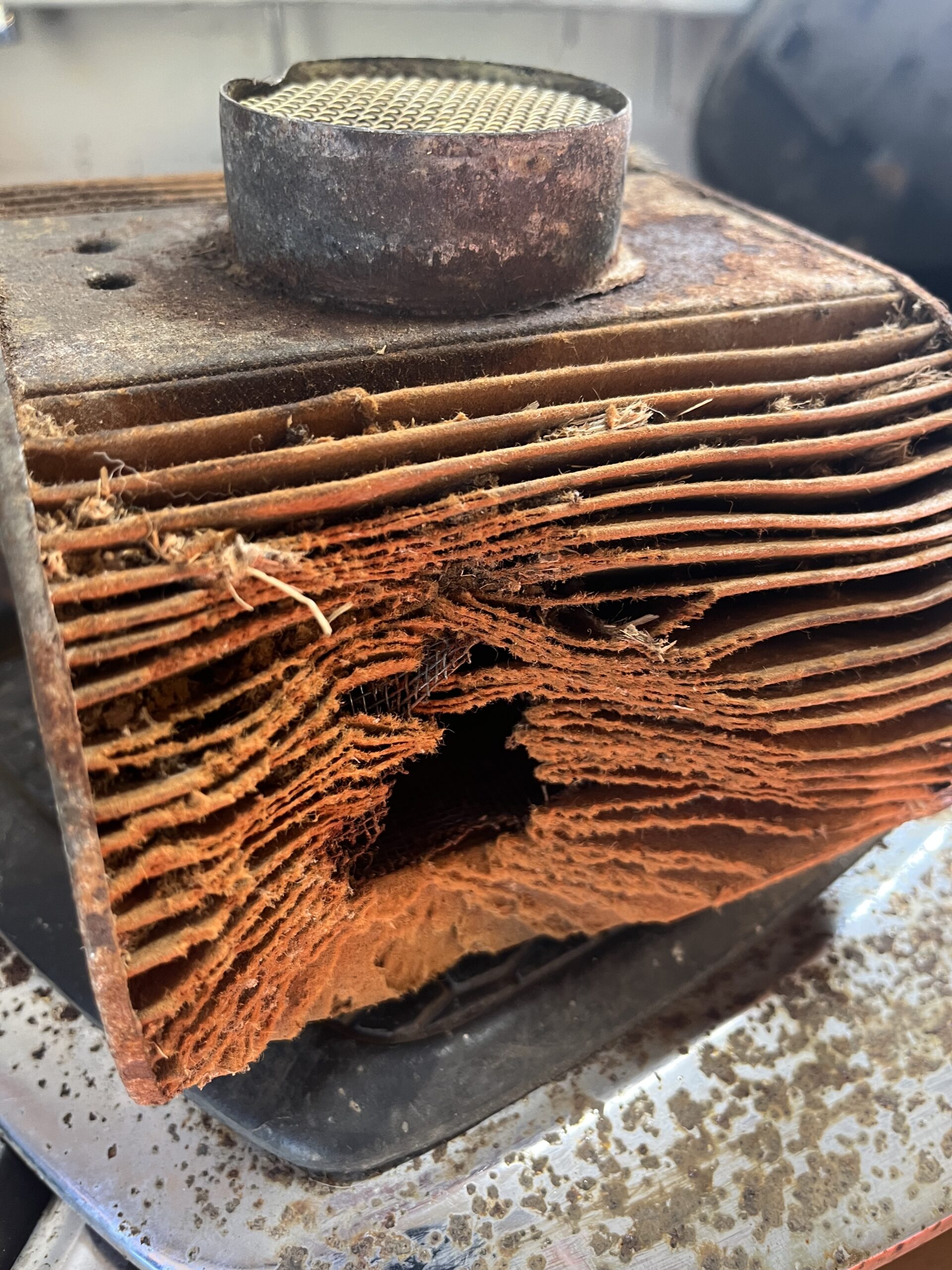
Days were spent extricating detritus from the frame, where a small colony of rodents had made a delightful home. The paper air filter served as master bedroom, with a neat, mouse-size hole leading to intricate rooms for the entire family. Nesting materials included straw, sticks, newspaper, pieces of cigarette packs, and the odd bottle cap. If I’m ever to name this motorcycle, I think I’ll call it Hantavirus.
Layers of some mysterious amalgam of grease, dirt, and congealed fuel were pressure-blasted away. Buckets of degreaser were applied to various engine bits. Wire wheels spun and whirred for hours.
Not a single nut or bolt yielded without a fight. My friend Tom, former head mechanic at the local KTM shop, recommended first touching a soldering gun to each one, until a thin plume of smoke rose from the offending item. Still, many bolts continued to laugh at me. The last resort was to drill them out, thin coils of metal littering the garage floor. Following this sequence, a simple crankcase cover screw could occupy me for the better part of an hour. Multiply by 20. You get the idea. Meredith would come out to the garage and find me nearly passed out from exhaustion, my hand wrapped around an impact driver like grim death, muttering unintelligible curses.
At one point, after removing the tank, I noticed a strange, metallic rattle. I couldn’t see anything inside, so I inverted the tank and shook it until the culprit fell out: a complete hacksaw blade! My riding buddy Ken offered a brilliant explanation: since the bike has no fuel gauge, perhaps the previous owner had used the hacksaw blade like a dip stick, to measure fuel depth. This worked great until that one time, in, say, 1968, when the blade fell in the tank. And there it sat, for six decades. (In case you wondered, it was extremely well-preserved; I added it to my stock.)
Horrible, violent noises emanate from the garage. Expletives are frequently heard. The First Aid kit and fire extinguisher are always close at hand. Meredith covers her ears and averts her eyes when in the garage, as one might do when passing a bad traffic accident. I’m forced to strip before re-entering the house, whereupon my clothes will be washed, or incinerated. Divorce lawyers stand ready. Welcome to my world.
But little did I know, my problems had barely begun.
Frozen in Time
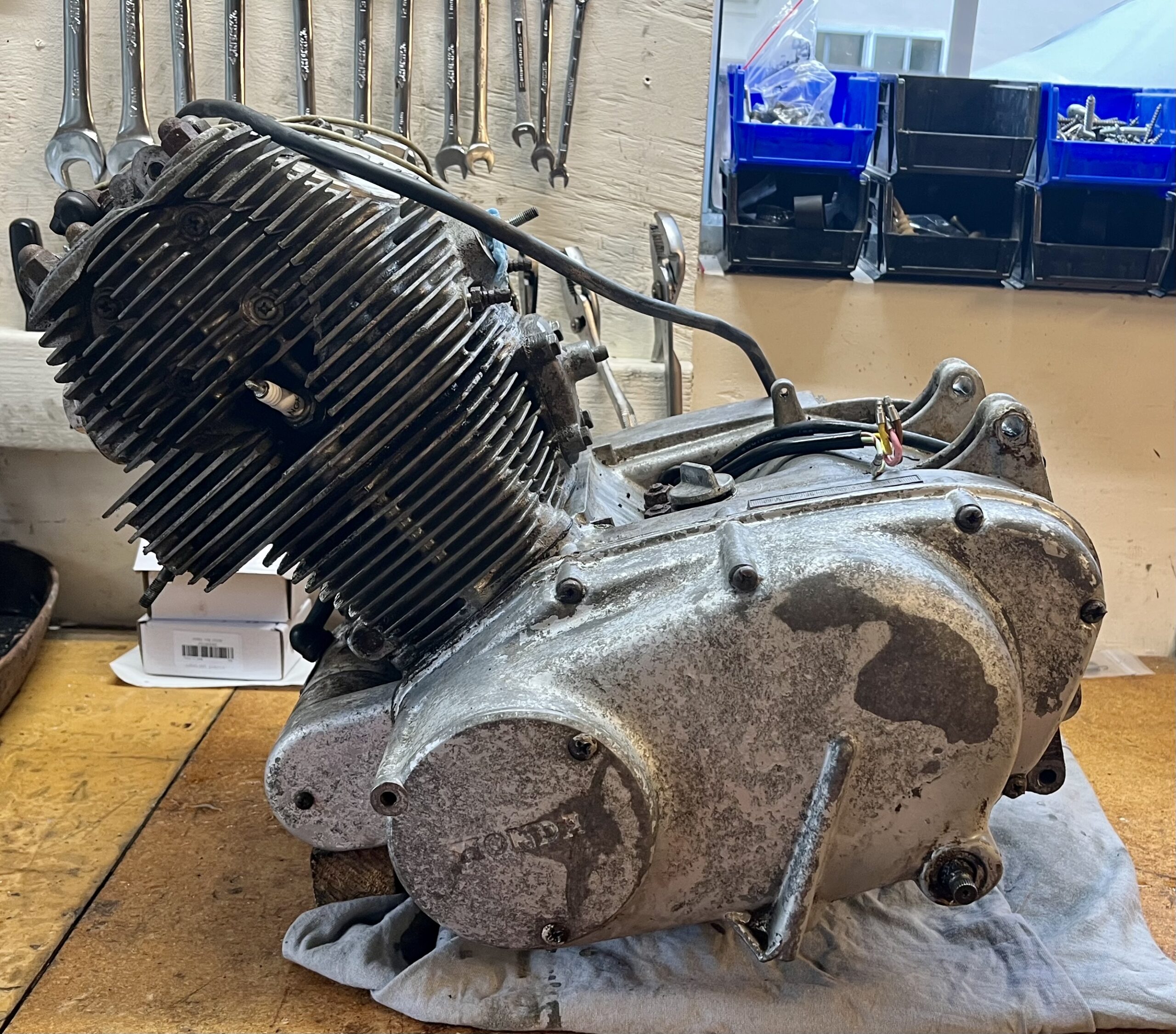
Through it all, there was the issue of the pistons, which were as frozen as the polar ice caps. No amount of solvent, heat, or violent activity with blunt objects has been able to move the 60-mm slugs in their bores.
My first step was to expose the troublesome pistons. But to remove the head, the cam chain would need to be separated. Naturally, the master link was buried deep in the crankcase, necessitating the shade-tree mechanic’s friend: the Dremel tool.
After cutting the chain (and wiring it to the studs so the pieces didn’t fall into the crankcase), I lifted off the head, and…eureka! There were the exposed piston crowns. This would be a simple matter, I reasoned, foolishly. Just pour some Marvel Mystery Oil on top, let the whole mess sit for a few days, tap with a hammer, and all would be well.
Oh foolish man!
Sledgehammers, drifts, and all manner of tectonic activity have failed to produce even a millimeter of movement. Friends proffer advice: acetone. Coca-Cola. Heat. Cold. Genuflections. Burning of incense. Rain dances. Perhaps I should take it to the nearby Stanford Linear Accelerator and subject it to a stream of electrons traveling at the speed of light.
I’ve also considered offering passers-by a go with a sledgehammer, like the carnival game you see at state fairs. Winner gets a teddy bear! Or a partially disassembled Honda Dream!
Naturally, in the face of these setbacks, I have responded with calm, intellectual curiosity, gentle persuasion…and violent, expletive-laden outbursts that have my neighbors wondering if they should call the sheriff to perform a safety check on the kook in the garage. Don’t worry, nothing to see here! Just a retired guy losing his marbles over an old motorcycle. I haven’t cried yet, but I might. And when I do, I’ll be sure to do it over the open cylinders, on the chance that tears are the ultimate solvent.
Restorations always have roadblocks and detours. This is an iceberg.
What’s Next
Lucky for me, I have other motorcycles to ride. But the little Honda continues to torment me. The rolling chassis and parts bins have been banished to the side yard, where they sit under cover. The engine was in the middle of my workbench for a month, taunting me with evil catcalls: “Come over here and try to budge my pistons!” So eventually it, too, was silenced through banishment to the side yard, looking forlorn, wrapped in a plastic garbage bag.
Wes Fleming, my colleague at this magazine, has proposed that we reprise Robert Pirsig’s legendary cross-country trip from the famed book, “Zen and the Art of Motorcycle Maintenance”. He’d ride his 1966 BMW R60/2, and I’d be on the Dream. (Persig and his son rode a 1966 Honda CB77 Super Hawk, the sportier relative of the Dream; while his partner and philosophical foil, John Sutherland, rode a BMW R60.) Right now this romantic but improbable idea is as frozen as my pistons. Neither bike is in a condition to ride across town, much less across the country.
In the meantime, do you have any interest in a partially disassembled but complete 1965 CA77 Honda Dream? I know a guy who’s got one. But watch out. I hear he’s not of sound mind….
Hi Geoff,
A friend showed me this article and suggested maybe I could help. “Maybe” is the key word, but I have had a lot of experience with freeing stuck engines. I did a Honda CL77 a couple of years ago and I can see one advantage you have in that your engine appears to be an early Honda 305 engine with the 360 degree crankshaft, meaning both pistons go up and down at the same time. So, if I was trying to free up your engine, this is what I would do:
First, fill up both cylinders with kerosene and let it sit for a week or more. Kerosene is the base fluid in most penetrating oils and is the best thing I’ve found for this purpose. One you have dumped the kerosene out, you need to make a pressure plate out of quarter inch of so steel and drill holes for the engine studs to fit through. (Drill at least 1/16 oversize to minimize screwing around.) Then you cut a couple of pieces of wood, with the grain vertical to fit between the pressure plate and the pistons so that only the stud threads are exposed. Then you simply wind the nuts (use washers on top of the plate) down about a half turn at a time, using the same pattern you would use if you were torquing down the head. The pistons will come free. I have to admit, when I did the CL77 (305 Scrambler) I got lazy and just used the head as the pressure plate. That had a 180-degree crankshaft buf fortunately only one piston was stuck. I usually cut the pieces of wood to size from a scrap piece of spruce 2×4. Just about anything can be used, but cedar would be too soft. I hope this helps!
Regards, Simon
Wow Simon I like that suggestion. And I’ve received quite a few.
The pistons have been soaking in various toxic liquids for months, to no avail. The current mix is acetone and ATF. I haven’t tried kerosene. Only the right piston seems to be problematic; solvents just sit in the bore like a little lake. Meanwhile, liquid drains around the sides of the left piston.
I’ll put some thought into implementing your suggestion! Thanks again, Geoff
That was a great read Geoff! Good luck with that motorcycle! 😎
Thanks Judy!